Financial inclusion is also about who gets to decide.
Together We Decide is an evidence-informed Behaviour Change Communication initiative that brings couples together to strengthen communication, joint financial decision-making, and women’s participation in decisions about household resources and microcredit
Together We Decide
Strengthening Joint Financial Decision-Making in Microfinance Households
Together We Decide (TWD) is an evidence-informed Behaviour Change Communication initiative that brings husbands and wives together to discuss financial priorities, make decisions collaboratively, and strengthen women’s participation in household financial decision-making. The programme responds to a critical challenge in financial inclusion: access to finance does not automatically mean having a voice in how financial resources are used.
Research and field experience show that women may receive microcredit in their own names while having limited influence over decisions about loan use, investment, savings, and household expenditure.
TWD helps turn access to finance into more meaningful participation in financial decisions.
Why Together We Decide?
Microfinance has expanded financial access for millions of women and families. Yet access to credit alone cannot guarantee that financial resources will be used productively or that women will have meaningful influence over household financial decisions.
Research has identified a recurring challenge: women often receive and repay microfinance loans while husbands or other family members make major decisions about how those funds are used. This separation between the borrower and the decision-maker can reduce the effectiveness of microcredit, limit women’s economic participation, and weaken the wider development potential of financial inclusion.
Partner organisations also recognised this issue through their own field experience. Staff and managers had observed households where women remained responsible for loan repayment but were not equally involved in financial decisions.
Together We Decide was developed to address this behavioural gap.
Rather than offering another financial literacy course, the programme focuses on something more fundamental:
How do couples communicate, negotiate, and make financial decisions together?
Our Approach
Together We Decide uses participatory Behaviour Change Communication to help couples reflect on existing financial practices and explore more collaborative approaches to managing household resources.
The programme combines:
research evidence on women’s entrepreneurship, household financial decision-making, financial inclusion, and related behavioural barriers;
practical implementation knowledge from organisations working directly with low-income households; and
behaviour change expertise in designing participatory activities suitable for community settings.
TWD is designed around one simple principle:
Financial decisions work better when people who share the responsibility also share the conversation.
What Happens in a TWD Session?
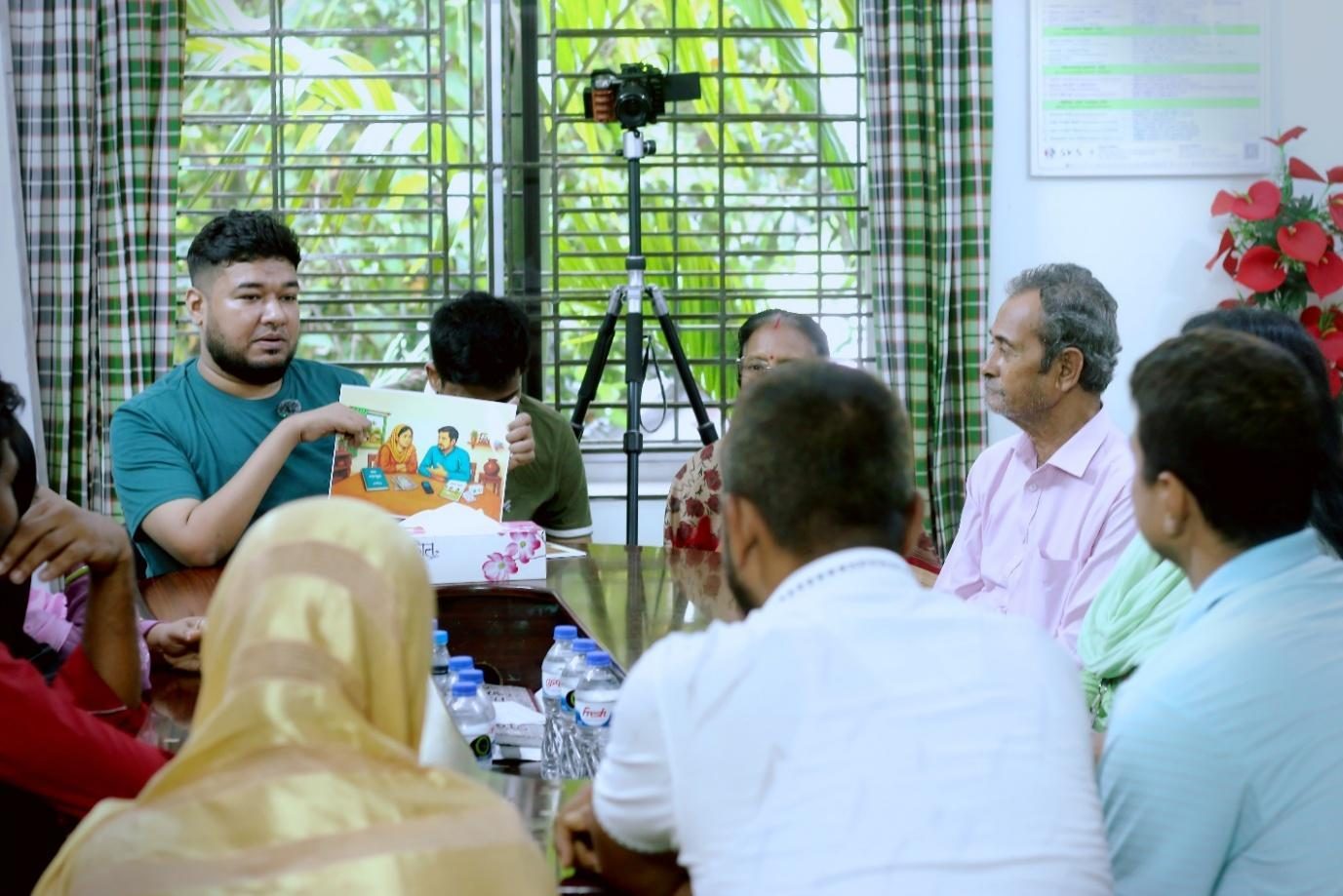
A TWD session brings couples together in a structured and respectful environment where they can discuss common financial situations without being required to publicly disclose personal disagreements.
The programme uses:
Storytelling Participants explore realistic household situations through stories and fictional scenarios.
Guided Discussion Couples reflect on financial priorities, responsibilities, and different perspectives.
Joint Decision-Making Exercises Participants practise making choices together around loans, savings, business investment, household expenditure, and financial trade-offs.
Household Budgeting Couples work through practical budgeting situations and consider how limited resources can be used more strategically.
Reflection Participants consider how different financial choices may affect their household, relationships, business activities, and wellbeing.
The use of fictional scenarios allows sensitive financial issues to be discussed without asking participants to expose personal conflicts in front of others.
Designed for Practical Delivery
Together We Decide was designed to work within existing microfinance operations rather than as a separate or highly resource-intensive project.
Each session:
Duration: Approximately 120 minutes Group size: Five couples Facilitation: Trained field staff Materials: Simple visual and participatory materials Method: Individual reflection, couple discussion, small-group learning, and practical exercises
The approach does not require specialised equipment and can be incorporated into routine client engagement activities.
Who Participates?
Together We Decide works with:
Existing microfinance clients and their spouses.
The programme intentionally engages both partners because sustainable household financial behaviour is difficult to change when only one person participates.
Joint participation creates opportunities for couples to:
discuss financial priorities;
understand each other’s perspectives;
negotiate competing demands;
plan the use of microcredit;
make budgeting decisions;
and practise collaborative financial decision-making.
The programme therefore moves beyond the traditional model of working only with the borrower and recognises the household as an important space where financial decisions are actually made.
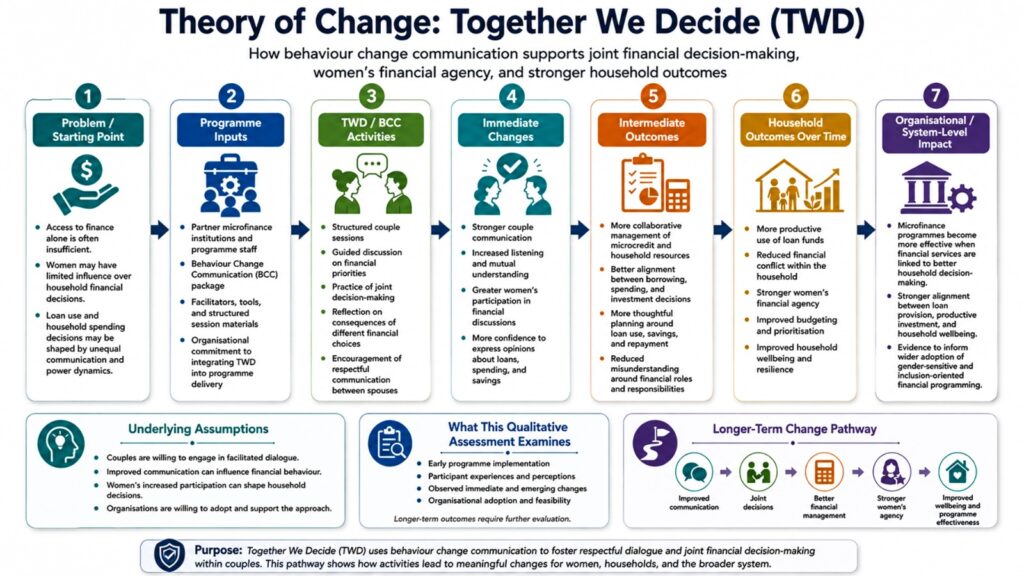
Theory of Change
Together We Decide begins with a simple recognition:
Access to finance is not enough when women have limited influence over household financial decisions.
By creating structured opportunities for couples to discuss financial priorities, practise joint decision-making, and consider the consequences of different financial choices, TWD aims to strengthen household communication and increase women’s participation in financial decisions.
Where We Work
Together We Decide is currently being implemented within partner microfinance programmes in two districts of Bangladesh:
Gaibandha
Implementation led by SKS Foundation and Gana Unnayan Kendra (GUK).
Barguna
Implementation led by JAGONARI.
Rather than establishing a separate pilot structure, TWD was integrated into existing microfinance activities so that the approach could be tested under conditions similar to normal programme delivery.
From Research to Practice
Together We Decide demonstrates how research evidence can be translated into a practical community-level intervention.
The programme was developed through collaboration between organisations with different strengths:
microfinance implementation;
community engagement;
Behaviour Change Communication;
participatory facilitation;
research;
and programme learning.
TIBF contributes expertise in Behaviour Change Communication and participatory facilitation, while research partners contribute the evidence base underpinning the programme.
This collaboration allows TWD to combine scientific evidence with the realities of programme implementation.
Early Learning from Implementation
An initial qualitative assessment was conducted to understand participant experiences, programme acceptability, implementation feasibility, and opportunities for refinement.
The assessment included:
participating couples;
field facilitators;
programme managers;
organisational leaders;
focus group discussions;
key informant interviews;
programme observations; and
reflective discussions.
The assessment was designed to understand early experiences and behavioural signals. It was not designed to measure long-term impact or establish causal programme effects.
Creating a Safe Space for Financial Conversations
Participants described TWD as providing an opportunity to discuss financial issues that were not always openly discussed within households.
The programme’s fictional scenarios, guided reflection, and practical exercises allowed couples to examine sensitive financial issues without requiring them to disclose personal disagreements publicly.
Facilitators observed that the structure encouraged both husbands and wives to participate and supported respectful discussion around financial priorities.
For some participants, the session was the first time they had discussed household financial decisions together in a structured environment.
Designed to Complement Microfinance
Together We Decide does not replace microfinance, financial literacy, or entrepreneurship programmes.
It complements them.
Traditional financial services primarily address access to financial resources. TWD focuses on the behavioural and relational processes that influence what happens after those resources enter the household.
Implementing organisations reported that the programme addressed issues conventional financial services rarely discuss, and programme managers considered the approach practical and relevant to clients.
Organisational Adoption
One of the most important outcomes of the initiative is the adoption of Together We Decide by participating microfinance organisations.
Following programme development and early implementation:
SKS Foundation Gana Unnayan Kendra (GUK) JAGONARI
adopted the Behaviour Change Communication approach within their microfinance programmes.
This represents an important step from experimentation toward institutional integration.
Instead of remaining a stand-alone activity, TWD is being incorporated into regular programme delivery.